Our Story
About The Founder

"We seek to inform future discussions around how machine learning can be used alongside traditional economic tools to strengthen government policymaking and policy implementation."
Jinlin Liu was born in Baotou, Inner Mongolia, China, and raised there. Both of his parents were teachers. Growing up, he was passionate about public speaking, which remained even when he immigrated to Canada. Having moved to numerous schools, he is currently a full IB DP student at Strathcona Tweedsmuir School.
This passion drove him to engage in numerous competitions at the national and international level, which in turn sparked his interest in economics.
He is currently the first author of an upcoming research paper titled: Minimum Wage Policy and Youth Labour Dynamics in Canada: A Machine Learning Approach to Causal Identification, which was presented at the international conference of IARMEA hosted at Cambridge on June 5th, 2026.
The Limits of Conventional Methods
Traditional Economics
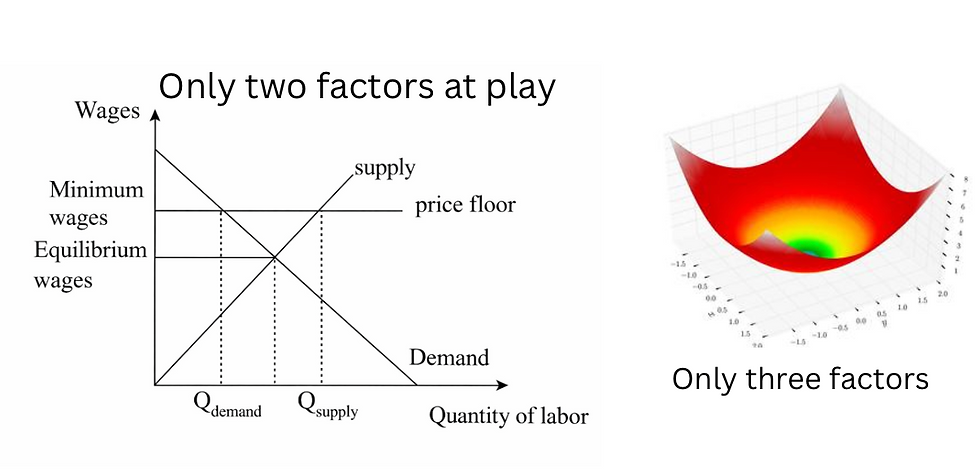
While conventional mathematical models used in economic research are undoubtedly useful and qualitative studies are likewise essential in supporting policy decisions by the government, quantitative research conventionally relies on certain assumptions to demonstrate that relationships between variables are indeed causative instead of merely correlative.However, such identifying assumptions rarely hold in reality. This uncertainty leads to delays in policymaking and implementation.
A More Nuanced Approach to Economic Relationships
Machine Learning
While conventional economic research relies on mathematical techniques such as regression or difference-in-differences, machine learning allows for a more nuanced approach that analyzes indirect relationships by accounting for multiple different mediators. Admittedly, most machine-learning algorithms are designed for prediction rather than explicit causal identification. However, this does not make their correlations useless for policy, since each mediator can act as a signal that guides the policy decision. If market power has a negative weight for the relationship between minimum wage and employment, even if that weight is correlative, the signal and associated effect the market is going to have on a minimum wage increase is still going to be visible
Understanding Relationships Through Decision Trees
Random Forest
The random forest algorithm is one of the most common algorithms used in machine learning. The forest itself is composed of decision trees, each of which has various individual “leaves” (nodes) which themselves are assigned context-dependent weights. These decision trees operate on a binary system: each node has two further nodes in the layer below, as seen in the figure, and it always chooses the node with greater weight.
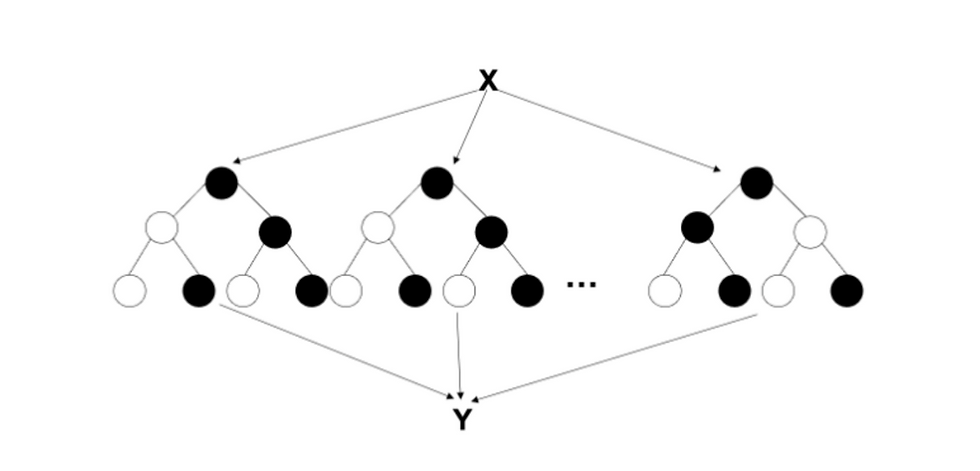
For example, as shown in the figure, the second layer of the leftmost decision tree has its right node chosen, indicating that its weight was greater.
As this process continues, a path that connects all the chosen nodes is formed.
Any unique configuration of a pathway would be considered a class. In the figure, the two left decision trees, then, would share the same class, but the rightmost tree does not. Finally, through a process known as bagging, the most frequently occurring class will be chosen as the result.
Understanding Relationships Through Hidden Layers
Neural Networks
A deep neural network is similar to a random forest as it also possesses multiple layers. Akin to most regression models, it creates a relation between two factors with an input layer and an output layer. However, different from such traditional models, it also accounts for hidden layers which connect the input and output layer, acting as functions that determine how the input layer affects the output layer.
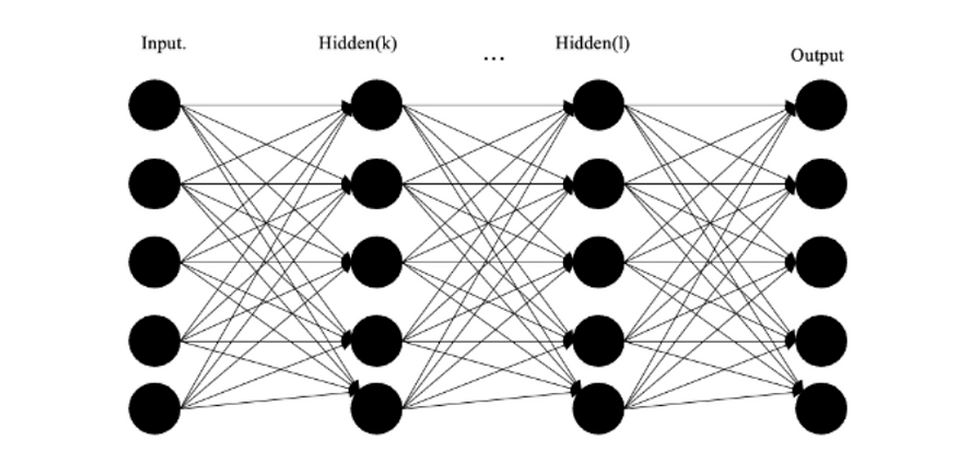
A neural network is likewise composed of nodes, though unlike a random forest, it is not necessarily binary. Rather, every single node from the first layer would connect to every single node in the second, and this process repeats until the output layer.